Benefits of Testimonials: Why Do They Matter for SaaS?

Key Highlights
-
Testimonials are one of the strongest trust signals in B2B SaaS, helping buyers reduce risk, validate decisions, and move faster across long and complex sales cycles.
-
Video and user-generated testimonials build stronger credibility than written claims by showing real customers, real outcomes, and authentic experiences.
-
Testimonials deliver the most impact when they are fresh, specific, and placed strategically across websites, sales conversations, and lifecycle campaigns.
-
Most SaaS teams fail to capture full value because testimonial collection and usage remain manual, scattered, and inconsistent.
-
Treating testimonials as infrastructure, not one-off assets, allows trust to compound over time and support sustainable growth.
-
ProofFlow turns testimonials into a repeatable trust engine by automating collection, approval, and activation directly inside HubSpot.
Building trust in B2B SaaS is not just difficult. It is expensive to get wrong. Buyers compare multiple vendors, involve finance and procurement, and challenge every claim. If your proof is vague, outdated, or generic, deals slow down. Even strong products lose momentum when credibility is unclear.
Today’s buyers rely heavily on peer validation before committing to high cost software decisions. According to Nielsen’s Global Trust in Advertising report, 92% of consumers say they trust recommendations from people they know over any other form of advertising, reinforcing how powerful external validation can be in decision making.
The real problem is rarely a lack of satisfied customers. It is operational breakdown. Testimonials sit in inboxes, hide in outdated PDFs, or disappear inside slide decks. When proof is scattered and inconsistent, it cannot reduce risk, support sales conversations, or move deals forward when it matters most.
What Are the Core Benefits of Testimonials for B2B SaaS?
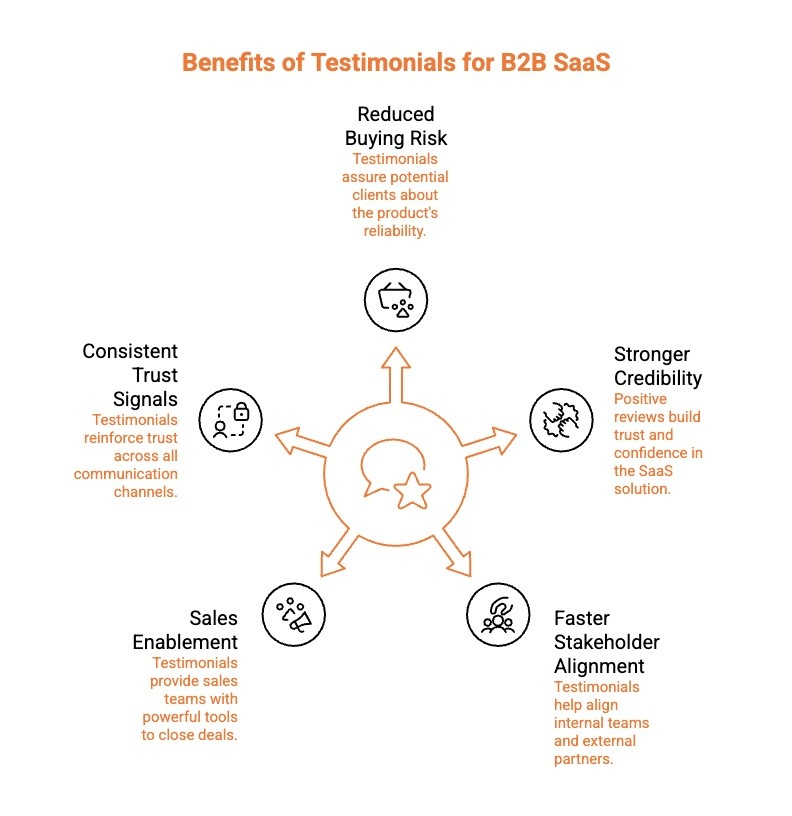
In B2B SaaS, trust shapes every buying decision. Buyers evaluate high cost solutions, involve multiple stakeholders, and compare similar sounding product claims. Testimonials reduce uncertainty by validating real outcomes in real business environments.
The benefits of testimonials are not limited to credibility alone. They directly support the buyer journey at every stage while accelerating revenue outcomes for SaaS teams.
Here is how testimonials create impact across B2B SaaS:
-
Reduced Buying Risk From the Start: At the awareness stage, buyers are just discovering possible solutions. Testimonials show that real companies already trust and use the product successfully. This early validation lowers skepticism and keeps prospects engaged.
-
Stronger Credibility During Consideration: As buyers compare vendors, they question claims and look for proof. Testimonials provide real world context by highlighting specific use cases, measurable results, and relatable challenges. This peer validation reduces objections and clarifies fit.
-
Faster Stakeholder Alignment: In B2B SaaS, decisions rarely involve one person. Testimonials help multiple decision makers align more quickly because they address common concerns early. Seeing similar teams succeed makes internal discussions smoother and shortens sales cycles.
-
Sales Enablement at the Decision Stage: When buyers reach demos, pricing reviews, or procurement, testimonials act as final reassurance. They help champions justify the purchase internally, reduce fear of making the wrong choice, and reinforce expected value.
-
Consistent Trust Signals Across Channels: Whether on landing pages, email campaigns, sales decks, or follow ups, testimonials reinforce confidence at every touchpoint. This consistency maintains momentum from first interaction to signed contract.
For B2B SaaS teams, testimonials are not just marketing assets. They are strategic trust drivers that reduce risk, strengthen credibility, accelerate deals, and support the entire buyer journey from awareness to decision.
Why Do Most SaaS Teams Struggle to Capture the Full Benefits of Testimonials?
Most SaaS teams understand the value of testimonials, but few use them effectively. Collection is often manual, inconsistent, and easy to deprioritize.
Below are the main reasons. SaaS teams struggle to unlock the full benefits of testimonials:
-
Manual Collection Processes: Chasing customers for testimonials takes time and often falls behind core priorities.
-
Poor Timing of Requests: Teams ask too early or too late, missing moments when customers are most willing to share.
-
Scattered Testimonial Storage: Testimonials live in emails, documents, or chat tools, making them hard to reuse.
-
Limited Internal Visibility: Sales and marketing teams cannot easily find or access relevant proof when needed.
-
Lack of Consistency: Without a system, testimonials become one-off assets instead of ongoing trust signals.
Without automation and structure, testimonials stay underused, limiting their impact on trust, conversions, and growth.
Also read: Many teams struggle because testimonial collection is still handled manually or outside their core systems. Learn how marketing automation platforms handle customer testimonials to streamline collection, approvals, and reuse across the buyer journey.
What Are the Benefits of Video and User Generated Testimonials in B2B SaaS?
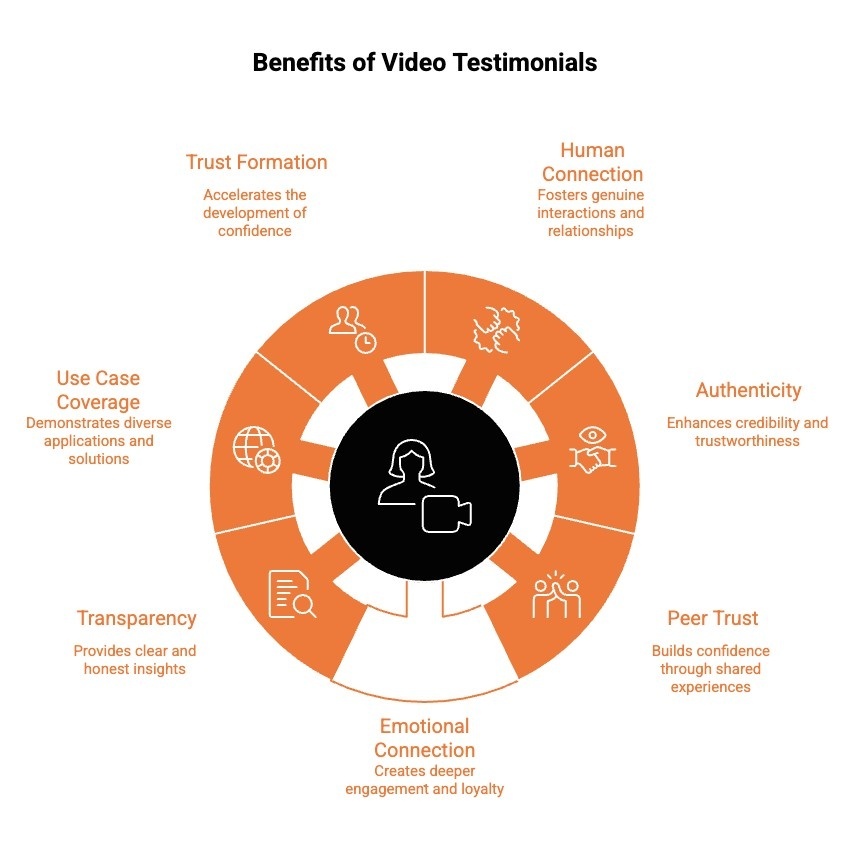
Building brand trust in B2B SaaS requires more than polished claims. Buyers want to see, hear, and relate to real customers before they believe performance promises. Video testimonials and user generated content work together to make trust visible, authentic, and scalable.
Here is how both formats strengthen credibility across long B2B buying journeys:
-
Human Connection That Feels Real: Video testimonials show real customers speaking in their own environment. Facial expressions, tone, and body language create relatability that written quotes cannot replicate. This human presence reduces skepticism and makes the brand feel approachable.
-
Higher Perceived Authenticity: Video feels harder to script or manipulate. Natural pauses and unscripted responses signal honesty. At the same time, user generated content in customers’ own words avoids overly polished marketing language. Together, these elements increase perceived authenticity and reinforce belief in the brand’s promises.
-
Peer Level Trust: B2B buyers trust people who sound like them. User generated testimonials reflect the language, challenges, and priorities of similar roles and industries. This peer validation makes feedback feel relevant and credible during evaluation.
-
Stronger Emotional Connection: Video captures tone and emotion such as relief, confidence, or satisfaction. Unfiltered user generated experiences add depth and realism. Emotional resonance plays a critical role in high value SaaS decisions where risk and responsibility are significant.
-
Greater Transparency: Video allows buyers to observe how customers discuss challenges, expectations, and outcomes. User generated testimonials provide diverse perspectives across use cases. This openness signals transparency and reduces uncertainty.
-
Broader Use Case Coverage at Scale: Diverse customer voices highlight multiple problems, industries, and results. Over time, a growing collection of user generated testimonials proves consistent value across segments, strengthening credibility with different buyer personas.
-
Faster Trust Formation: Because video communicates visual, verbal, and emotional signals at once, and user generated content reflects relatable peer experiences, buyers reach confidence more quickly. Prospects move from awareness to consideration with fewer doubts.
For B2B SaaS companies, video and user generated testimonials transform real customer voices into powerful trust signals. By combining authenticity, emotional impact, and peer validation, they create scalable credibility that supports the entire buyer journey.
How Does ProofFlow Turn the Benefits of Testimonials Into a Repeatable Trust Engine?
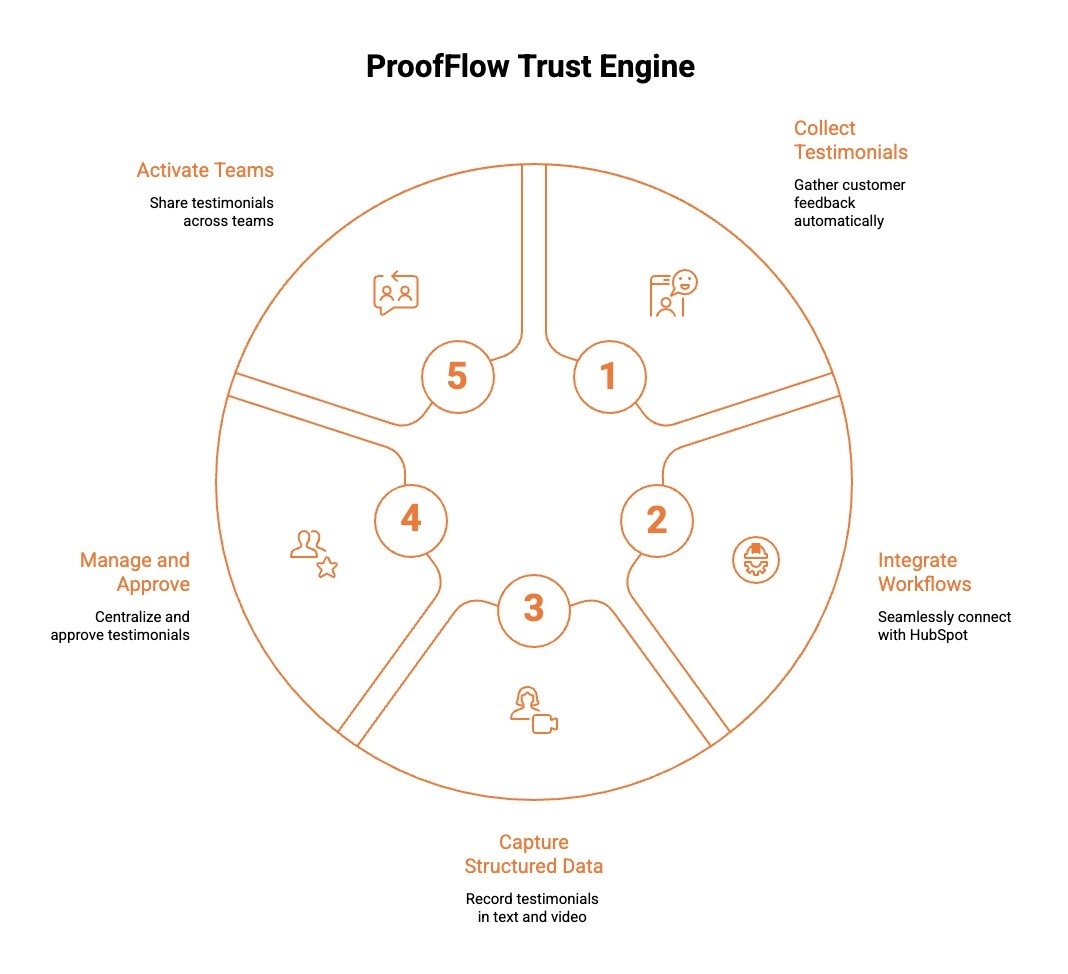
Testimonials create trust, but without structure they stay scattered and underused. ProofFlow turns customer proof into a system by embedding testimonial workflows directly into HubSpot. This makes trust consistent, timely, and scalable.
Here is how ProofFlow turns testimonials into a repeatable trust engine:
1) Automated Testimonial Collection
ProofFlow automates testimonial requests at the right moments in the customer lifecycle, such as after positive feedback or key milestones. This removes manual follow-ups and ensures testimonials are collected consistently. By timing requests correctly, teams capture higher-quality responses without adding work for marketing or customer success.
2) HubSpot-Native Workflows
Because ProofFlow works inside HubSpot, testimonials connect directly to existing CRM data and workflows. This keeps customer proof tied to real contacts, companies, and lifecycle stages. Teams avoid disconnected tools and can manage testimonials as part of their core growth stack.
3) Structured Text and Video Capture
ProofFlow guides customers through structured prompts for both text and video testimonials. This ensures responses are specific, usable, and aligned with real outcomes. Structured capture reduces vague praise and produces testimonials that clearly communicate value across marketing and sales channels.
4) Centralized Approval and Management
All testimonials are stored, reviewed, and approved in one place. ProofFlow simplifies consent tracking and usage permissions, making it easy to reuse testimonials confidently. Teams no longer lose proof in emails or documents, and sales and marketing can access trusted assets instantly.
5) Easy Activation Across Teams
ProofFlow makes testimonials easy to activate across websites, emails, sales decks, and demos. Because proof is organized and accessible, teams use testimonials consistently instead of occasionally. This turns customer voices into ongoing trust signals throughout the buyer journey.
By automating, structuring, and activating testimonials, ProofFlow transforms customer proof into a reliable trust engine that scales with the business.
Why Testimonial Automation Turns Proof Into Growth Infrastructure?
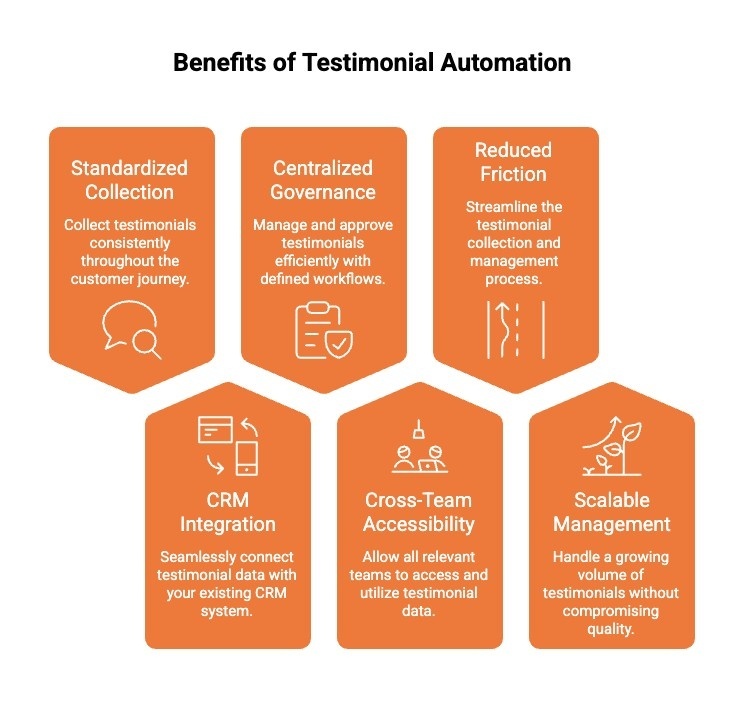
Manual testimonial collection may work in the early stages of a SaaS company, but it quickly becomes inconsistent, reactive, and difficult to scale. As teams grow, scattered proof creates friction, outdated assets weaken credibility, and internal visibility declines. Testimonial automation addresses these operational gaps by transforming customer feedback into structured infrastructure embedded within core workflows.
Here is how testimonial automation drives operational transformation:
1) Standardized Collection Across the Lifecycle
Automation replaces ad hoc outreach with structured workflows triggered at predefined lifecycle milestones such as onboarding completion, product adoption thresholds, renewals, or positive feedback events. This creates consistency in how and when testimonials are requested, eliminating reliance on memory or manual follow ups.
Instead of occasional bursts of activity, teams maintain a predictable testimonial pipeline aligned with customer milestones.
2) Embedded CRM Integration
When testimonial automation operates directly inside systems like HubSpot, customer proof becomes connected to contacts, companies, deals, and lifecycle stages. Testimonials are no longer isolated marketing assets stored in folders or emails. They become structured CRM records with full business context.
This integration improves traceability, reporting visibility, and alignment between marketing, sales, and customer success.
3) Centralized Governance and Approval Workflows
Automation introduces clear review, approval, and consent processes. Testimonials move through defined stages before activation, ensuring accuracy, compliance, and brand consistency.
This prevents outdated quotes, unclear permissions, or unverified claims from being published. Governance reduces risk while increasing confidence in reuse across channels.
4) Cross-Team Accessibility and Visibility
With a centralized, automated system, approved testimonials are discoverable by all relevant teams. Sales can filter by industry, persona, or use case. Marketing can match proof to campaign themes. Customer success can reference outcomes during renewals.
Automation eliminates silos and ensures customer proof is operationally usable across departments.
5) Reduced Process Friction
Manual testimonial management involves repeated follow ups, scattered storage, inconsistent formatting, and version confusion. Automation removes these inefficiencies by guiding customers through structured prompts, storing responses in a unified system, and preparing assets for immediate activation.
This shift frees teams from administrative overhead while preserving quality and consistency.
6) Scalable Proof Management
As customer volume increases, testimonial management becomes more complex. Automation ensures that growth does not create disorder. Instead of testimonials becoming harder to manage over time, the system strengthens as more proof is added.
Customer voice becomes a managed asset, not a growing operational burden.
Testimonial automation does more than simplify collection. It embeds customer proof into CRM workflows and lifecycle processes, transforming testimonials from scattered assets into structured, repeatable infrastructure.
When implemented correctly, testimonials shift from occasional marketing content to a reliable system that supports cross team execution and scalable growth.
Also read: Once teams recognize the need for automation, choosing the right platform becomes critical. Explore a breakdown of the top testimonial management tools and how they compare for collecting, managing, and activating customer proof at scale.
What Common Mistakes Prevent Teams From Seeing the Benefits of Testimonials?
Many teams invest time collecting testimonials but fail to see results. The issue is rarely the proof itself, but how it is handled and used. Small process gaps reduce impact.
Here are common mistakes that limit the benefits of testimonials:
-
Vague Testimonials: Generic praise without outcomes fails to persuade serious buyers.
-
Poor Placement: Testimonials buried on low-traffic pages go unnoticed.
-
Outdated Proof: Old testimonials weaken relevance and trust.
-
Manual Management: Scattered storage makes reuse difficult across teams.
-
Missing Consent: Lack of approval limits where testimonials can be used.
Avoiding these mistakes helps teams turn testimonials into consistent, high-impact trust drivers.
Conclusion
The benefits of testimonials go far beyond social proof when they are treated as a system rather than one-off assets. For B2B SaaS teams, consistent, timely customer proof reduces risk, builds confidence, and supports decisions across the entire buyer journey.
When testimonials are automated, structured, and activated inside HubSpot, trust becomes repeatable instead of reactive. ProofFlow enables teams to collect better testimonials, keep them current, and use them where they matter most. The result is stronger credibility, faster sales cycles, and a scalable trust engine that grows alongside the business.
Frequently Asked Questions
How do testimonials help build credibility and trust with potential customers?
The importance of customer testimonials lies in showing the actions of others. Positive testimonials reduce risk for prospective customers and potential buyers. The benefits of customer testimonials include stronger credibility, smoother sales process alignment, and greater confidence in real experiences.
Why are video testimonials considered more effective than written testimonials?
The benefits of video testimonials are rooted in authenticity. A testimonial video captures tone and emotion that text cannot. The benefits of video testimonials for building brand trust are stronger because customer testimonial videos show real people sharing positive experiences.
Are there any overlooked advantages of including testimonials on a website?
The benefits of testimonials on website pages extend beyond conversion rates. They add a huge amount of credibility, support customer review sites and Google My Business visibility, and strengthen the importance of testimonials in digital marketing across social media platforms and marketing campaigns.
How should businesses collect and display testimonials effectively?
The best way to maximize the importance of client testimonials is to request feedback after positive experiences from current customers. Great testimonials should appear across marketing materials, social media, Google Business profiles, and sales process touchpoints to support new customers.
What are the 3 C’s of customer satisfaction?
Consistency, communication, and care influence personal recommendations and increase the number of positive testimonials. Strong customer service is an important factor that drives positive experiences, strengthens local businesses, and reinforces the importance of testimonials in digital marketing.
What are the 4 P’s of customer experience?
People, process, product, and perception shape how prospective customers evaluate new business. When aligned, they generate positive testimonials and customer reviews, improve conversion rates, and support the importance of customer testimonials across marketing campaigns.
Do testimonials affect customer loyalty and repeat business?
Yes. Positive testimonials validate decisions and act as a green light for potential buyers. A powerful testimonial reinforces trust, supports new customers, reduces the impact of negative reviews, and strengthens long term loyalty throughout the sales process.
Ready to automate your testimonial collection?
Get full access to ProofFlow at no cost during our free beta. The complete testimonial automation platform for HubSpot.
Get Started Free