HubSpot Marketing Hub Scalability for Growing Teams
Key Highlights
-
Marketing scalability becomes critical as teams manage higher lead volumes, multi-channel campaigns, and complex buyer journeys.
-
Non-scalable tools create friction through manual work, fragmented data, and inconsistent campaign performance.
-
HubSpot Marketing Hub supports growth by scaling data management, automation, and reporting without system rebuilds.
-
CRM-connected marketing ensures alignment across marketing, sales, and customer success as organizations grow.
-
Scalable operations improve day-to-day execution, predictability, and cross-team collaboration.
-
For mid-size B2B SaaS companies, HubSpot Marketing Hub scalability enables long-cycle buying, account-based engagement, and revenue-linked attribution
Growing marketing teams often feel the strain before they see the results. Tools that once worked begin to break under pressure, manual work increases, and teams struggle to manage rising volumes of qualified leads, ongoing email marketing, and fragmented marketing efforts across channels.
Scaling successfully requires more than adding tools or people. It demands systems that support consistent marketing automation, coordinated digital marketing, reliable conversion rates, and repeatable marketing campaigns across social media, acquisition funnels, and post-signup journeys such as the free trial, while preserving clean data and strong customer relationships.
If you are evaluating whether HubSpot Marketing Hub can support that level of growth, this guide will help you understand where scalability breaks down, what effective scaling actually looks like, and how the right platform supports sustainable performance as teams and expectations grow.
What Does Scalability Mean In The HubSpot Marketing Hub?
In practice, scalability in HubSpot Marketing Hub means marketing continues to operate smoothly as volume and complexity increase without slowing teams or forcing system changes.
It shows up day to day as:
-
Handling growth in data and demand by managing larger contact databases, trials, and lead flows while maintaining accurate segmentation and lifecycle tracking.
-
Expanding automation safely so teams can run more campaigns, channels, and journeys without rebuilding workflows or losing operational control.
HubSpot scales by allowing teams to increase output and sophistication while keeping execution simple, reliable, and measurable.
How are customer testimonials managed at scale? Understand how marketing automation platforms collect, organise, and activate testimonials to improve credibility and keep buyers engaged throughout the funnel.
What Happens When Marketing Tools Fail to Scale?
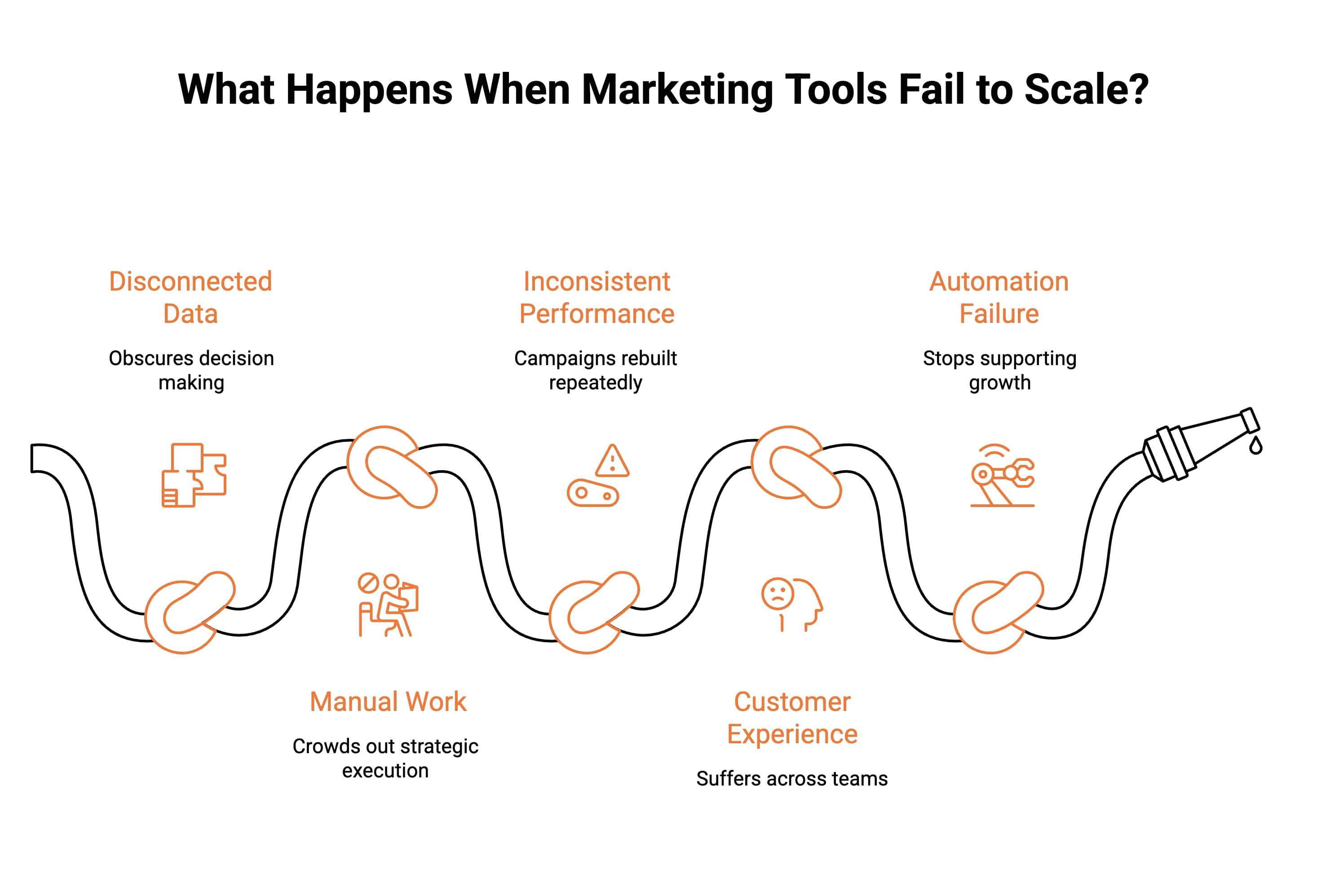
When marketing tools stop scaling, issues compound across execution, data, and accountability. What once worked for small teams starts creating friction, slowing growth, and increasing costs. These problems rarely appear at once, but they steadily undermine performance as volume, expectations, and complexity rise.
Below is how scalability breakdown typically shows up inside growing marketing teams:
1. Disconnected Data Obscures Decision Making
As tools fail to scale, data fragments across platforms, managing landing pages, website visitors, and new customers. Teams lose access to valuable insights in real time, making it harder to evaluate organic traffic, understand buyer behaviour, or confidently adjust marketing strategy.
2. Manual Work Crowds Out Strategic Execution
Without scalable systems, teams rely on spreadsheets and repeated setup for content marketing, content creation, and campaign launches. Instead of focusing on optimisation, teams spend time maintaining processes, increasing customer acquisition cost and limiting the ability to move faster with the right tools.
3. Campaign Performance Becomes Inconsistent
When platforms cannot scale, campaigns are rebuilt repeatedly with different rules and logic. This inconsistency affects conversion tracking, follow-ups, and engagement with potential customers, reducing reliability across channels and weakening confidence in performance trends and outcomes over time.
4. Customer Experience Suffers Across Teams
As scale increases, disconnected systems weaken the customer experience. Marketing loses alignment with sales and customer service, while data gaps between the sales hub and service hub create friction in handoffs, onboarding, and long-term relationship management.
5. Automation and Attribution Stop Supporting Growth
Without scalable workflow automation, teams struggle to connect activity to outcomes. Reporting cannot clearly show impact on revenue, making it harder to justify spend, explain performance, or understand how HubSpot’s Marketing Hub supports growth across the full funnel.
When marketing tools fail to scale, growth continues at a surface level, but efficiency, clarity, and confidence decline, quietly limiting long-term impact and revenue contribution.
Why do HubSpot testimonials influence buying behaviour? Explore how customer testimonials within HubSpot help build trust, reduce hesitation, and support faster, more confident purchase decisions.
How HubSpot Marketing Hub Scales With Your Team?
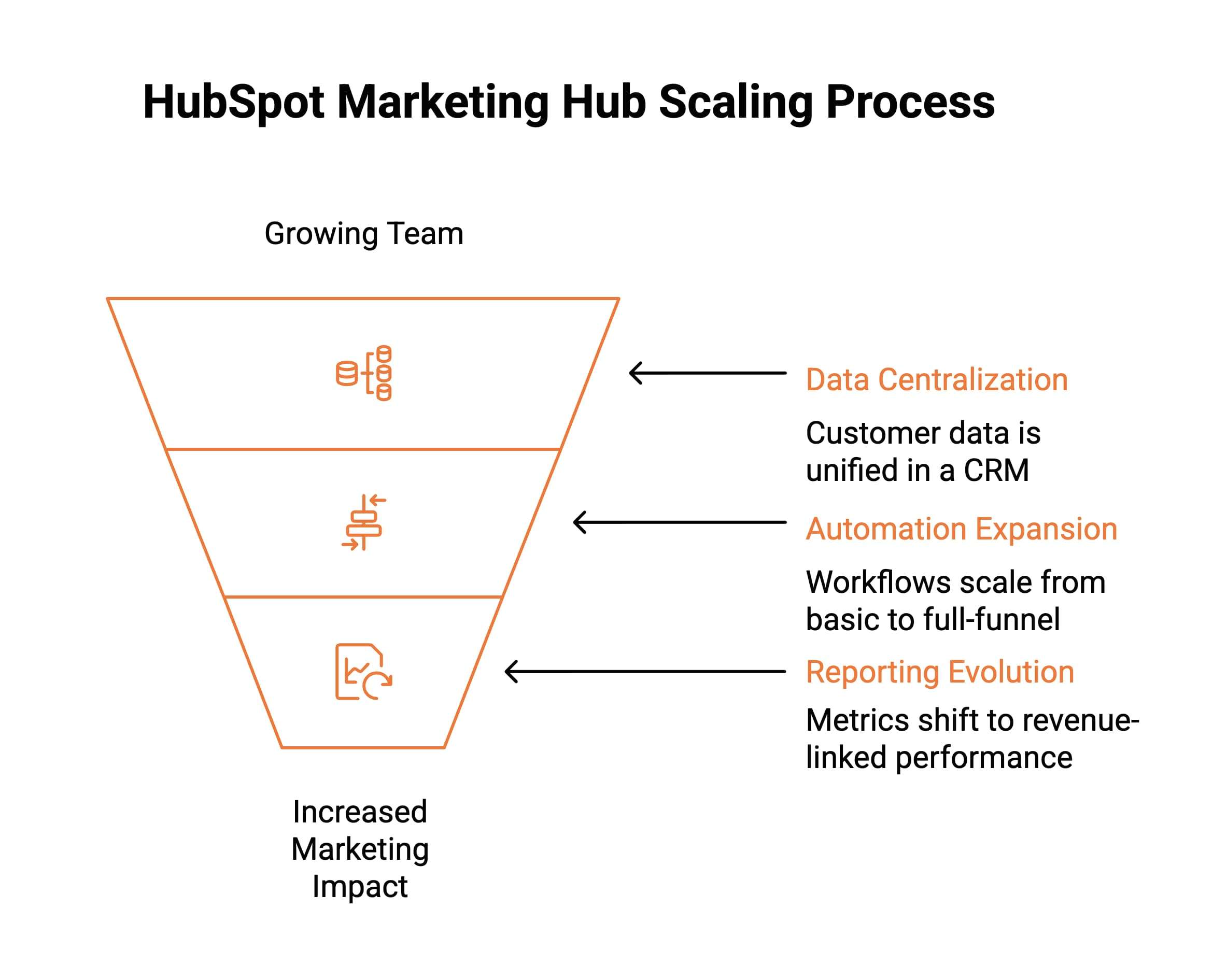
As teams grow, marketing complexity increases across data volume, campaign execution, and performance accountability. HubSpot Marketing Hub is built to scale across these pressures by expanding capability without fragmenting systems, processes, or visibility, keeping marketing aligned with sales and revenue as the organization matures.
1. Data Scalability
HubSpot scales by centralising customer data across marketing, sales, and service in a single CRM foundation. As contact records, accounts, and lifecycle interactions increase, teams retain a unified view of the customer journey, enabling consistent segmentation, accurate lifecycle tracking, and cleaner handoffs between teams without data silos.
2. Automation Scalability
As campaign volume and program complexity grow, HubSpot allows teams to scale automation without rebuilding systems. Workflows expand from basic lead nurturing into full-funnel lifecycle automation, supporting SaaS acquisition, activation, and expansion motions while maintaining control, governance, and operational efficiency across teams.
3. Reporting Scalability
HubSpot’s reporting scales alongside leadership expectations. As teams grow, reporting evolves from channel-level metrics to revenue-linked performance views, connecting marketing activity to pipeline, customer outcomes, and long-term growth. This ensures decision-makers retain clarity as data volume, stakeholders, and accountability increase.
HubSpot Marketing Hub scales with your team by strengthening data integrity, expanding automation without complexity, and maintaining revenue-aligned reporting, allowing growing organizations to increase impact without outgrowing their marketing infrastructure.
How Scalability Changes Day-to-Day Marketing Operations?
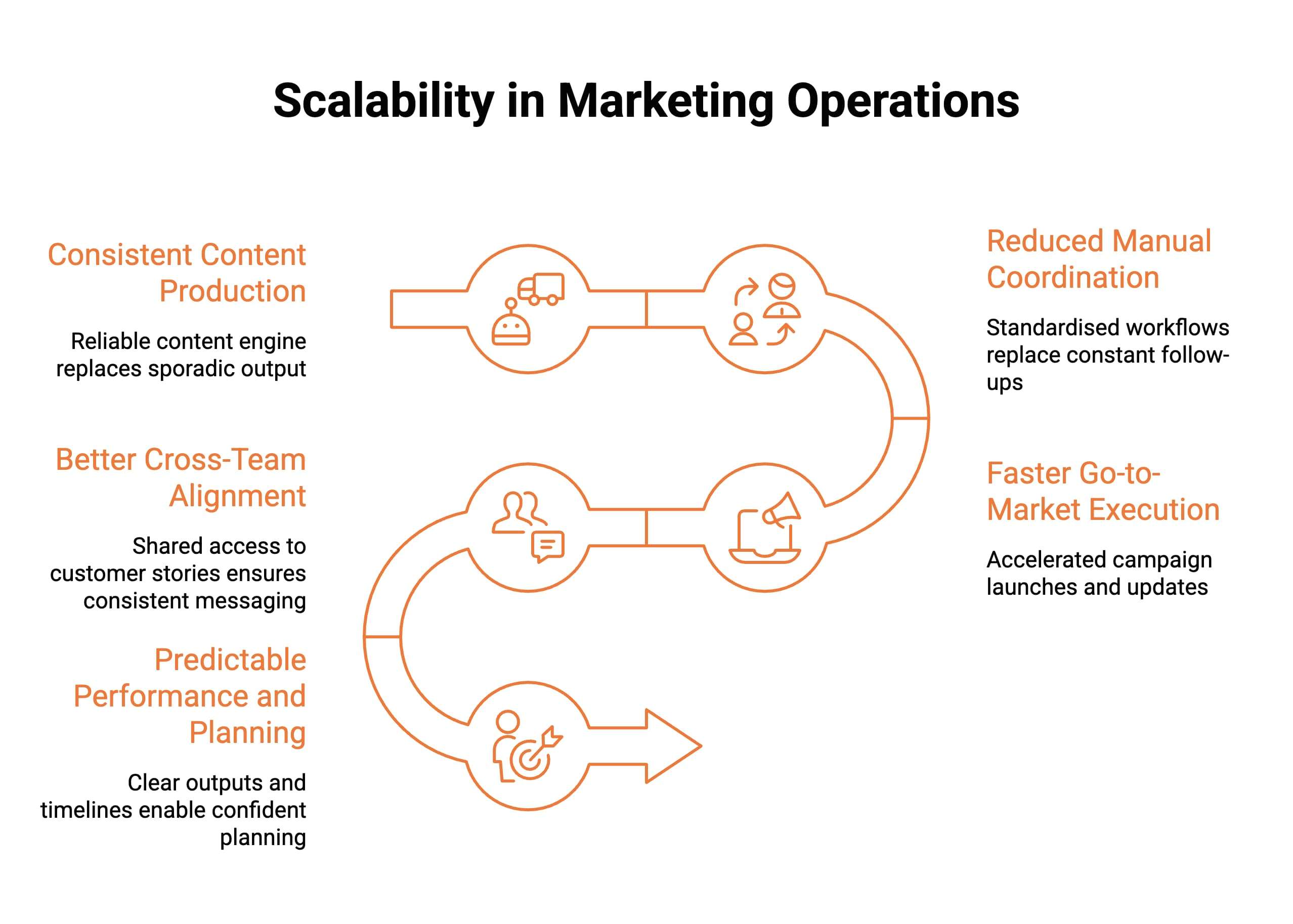
Scalability fundamentally changes how marketing teams operate day to day. Instead of reacting to constant requests and bottlenecks, teams work within repeatable systems.
This shift improves speed, consistency, collaboration, and decision-making, allowing marketing operations to support growth without adding unnecessary complexity or burnout risk.
Here’s how scalable operations show up in everyday marketing work:
1. Consistent Content Production
Scalable operations create a reliable content engine, replacing sporadic production with planned output. Customer stories, campaigns, and assets are delivered consistently, reducing last-minute stress. Teams know what is coming next, when it will ship, and how it supports broader marketing goals across channels, regions, teams, launches, and timelines.
2. Reduced Manual Coordination
Scalability reduces manual coordination by standardising interviews, approvals, editing, and publishing. Clear workflows replace constant follow-ups and internal chasing. Marketing leaders spend less time managing logistics and more time focusing on strategy, optimisation, and performance improvements that directly influence pipeline velocity, forecasting, alignment, execution, efficiency, confidence, and growth.
3. Faster Go-to-Market Execution
With scalable systems, go-to-market execution accelerates. Teams can launch campaigns, sales enablement assets, and website updates without waiting for last-minute case studies. Faster turnaround improves relevance, competitive positioning, and the ability to respond quickly to market opportunities across regions, segments, channels, audiences, timelines, priorities, and cycles.
4. Better Cross-Team Alignment
Scalable marketing operations improve alignment between marketing, sales, and leadership. Shared access to customer stories ensures consistent messaging across touchpoints. This alignment reduces friction, strengthens trust, and helps teams move faster together while supporting revenue-focused objectives across teams, regions, funnels, stakeholders, campaigns, decisions, priorities, execution, outcomes, and growth.
5. Predictable Performance and Planning
Scalability makes performance predictable by creating clear outputs, timelines, and expectations. Marketing leaders can plan campaigns with confidence, allocate resources accurately, and measure impact over time, rather than reacting to delays, gaps, or inconsistent delivery across quarters, budgets, teams, channels, forecasts, goals, leadership, reporting, planning, accountability, stability, and scale.
Scalable marketing operations turn daily execution from reactive work into a structured system that supports sustainable growth, clearer priorities, and stronger business impact over time.
Learn how automated testimonial video workflows simplify collection, improve response rates, and strengthen marketing campaigns in this blog.
Why HubSpot Marketing Hub Scales for Mid-Size B2B SaaS Companies?
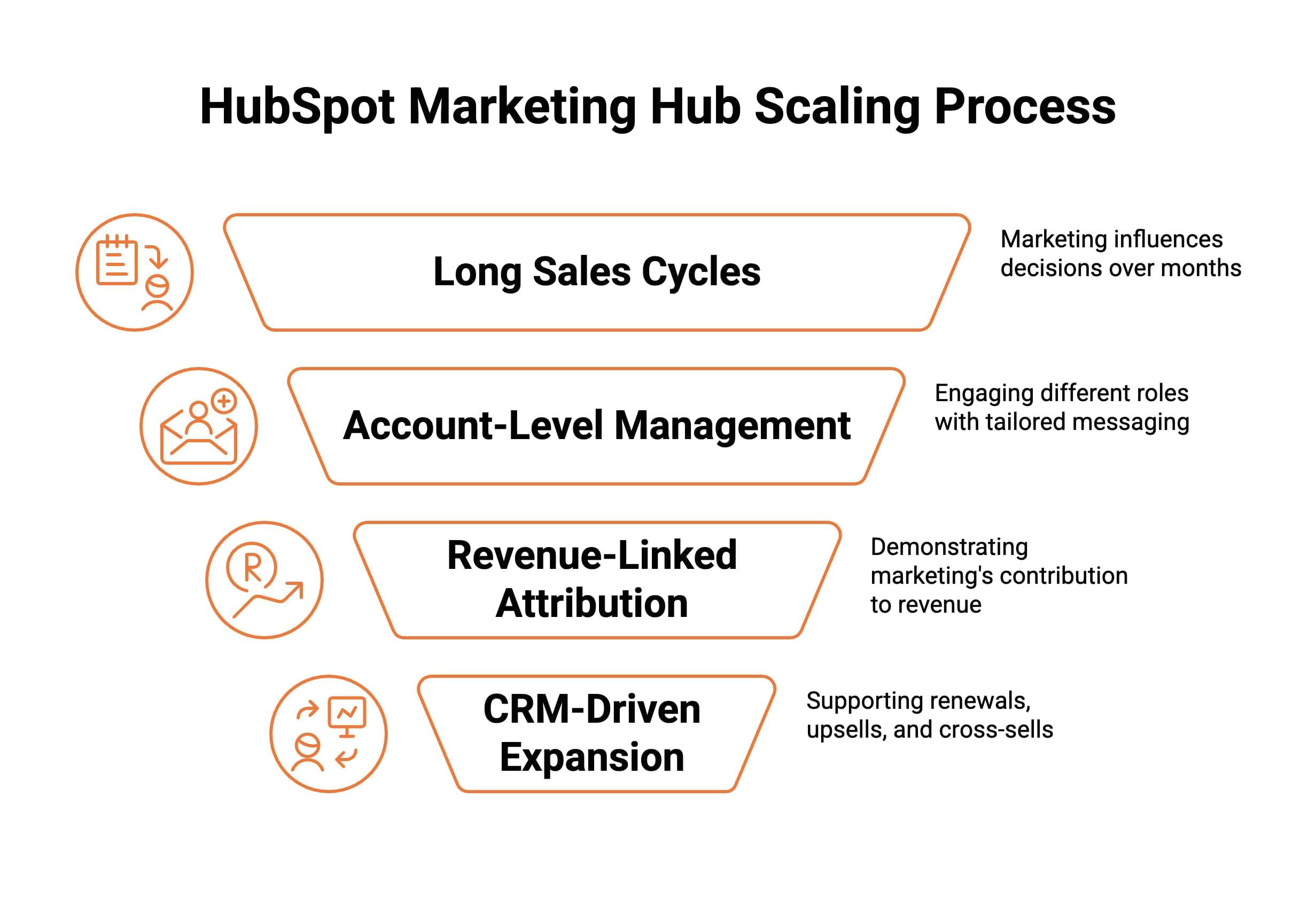
Mid-size B2B SaaS teams face long sales cycles, multiple decision-makers, and revenue pressure across the full customer lifecycle, requiring marketing systems that support account-based buying, attribution clarity, and expansion-led growth.
1. Long Sales Cycles with Multiple Stakeholders
Mid-size B2B SaaS companies sell through extended evaluation cycles involving finance, IT, leadership, and end users. Marketing must influence decisions over months while supporting sales conversations and internal alignment across the same target account.
HubSpot Marketing Hub achieves this by structuring engagement around company records and lifecycle stages, ensuring every interaction stays connected across time rather than being treated as isolated lead activity.
2. Account-Level Management of Buying Committees
SaaS buying decisions are made by groups, not individuals. Marketing needs to engage different roles with tailored messaging while maintaining a single view of the account journey.
HubSpot supports account-based engagement by linking contacts to shared company records, allowing role-specific nurturing while preserving a unified account history that reflects how buying committees actually operate.
3. Revenue-Linked Attribution for Spend Justification
In SaaS, conversions often occur long after the first marketing touch. Leadership needs proof that early- and mid-funnel efforts contribute to revenue, not just traffic or leads.
HubSpot’s multi-touch attribution connects campaigns and content across the full sales cycle, allowing marketers to demonstrate how marketing activity influences pipeline progression and closed deals.
4. CRM-Driven Expansion and Retention Growth
For mid-size SaaS companies, sustainable growth depends on renewals, upsells, and cross-sells. Marketing must stay involved beyond acquisition to support lifecycle revenue.
Through native CRM alignment, HubSpot enables marketing to trigger onboarding, adoption, renewal, and expansion programs based on real sales activity and lifecycle signals, keeping marketing tied to revenue after the deal closes.
HubSpot Marketing Hub scales for mid-size B2B SaaS companies because it is designed around SaaS buying behavior, committee-driven decisions, long revenue cycles, and lifecycle-based growth, rather than around short-term campaign execution.
How HubSpot CRM Features Support B2B SaaS Scalability?
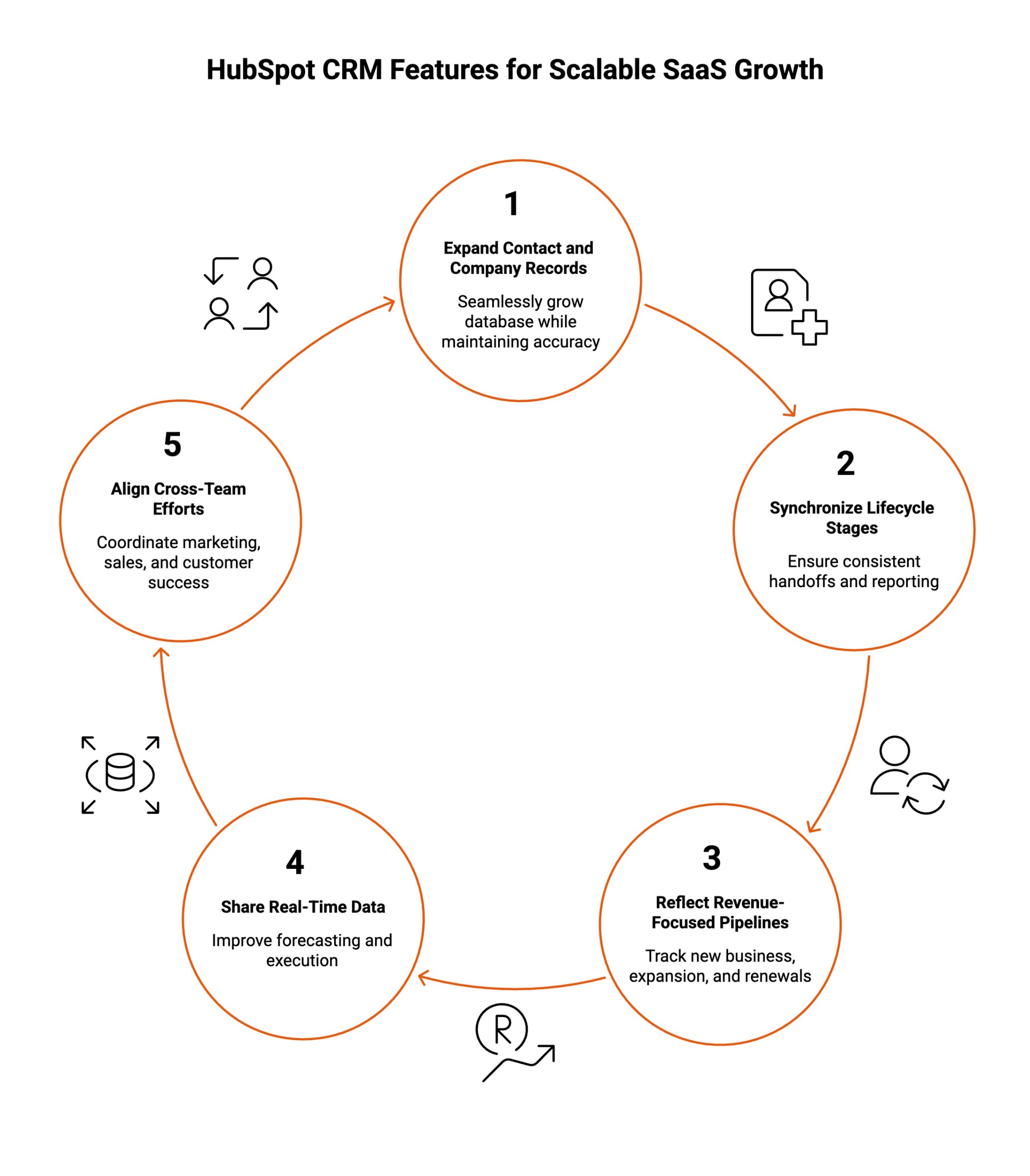
Marketing does not operate in isolation, especially within SaaS organizations where growth depends on alignment between marketing, sales, and customer success. Scalable marketing requires reliable CRM capabilities that support personalization, data integrity, and cross-functional visibility across the entire revenue lifecycle.
This is where HubSpot CRM features for b2b saas play a critical role in enabling long-term scalability.
-
Scalable Contact and Company Records: Contact and company records expand seamlessly as databases grow, maintaining structure and data accuracy.
-
Unified Lifecycle Stages: Lifecycle stages remain synchronized across teams to support consistent handoffs and reporting.
-
Revenue-Focused Deal Pipelines: Deal pipelines reflect new business, expansion revenue, and renewals for complete revenue visibility.
-
Shared Data Foundation: Marketing and sales teams operate from the same real-time data to improve forecasting and execution.
-
Cross-Team Alignment: CRM visibility supports coordination across marketing, sales, and customer success teams.
These CRM features ensure teams remain aligned as complexity increases, making HubSpot a strong foundation for scaling SaaS revenue operations.
What Are The Scalability Best Practices For Growing Teams Using Marketing Hub?
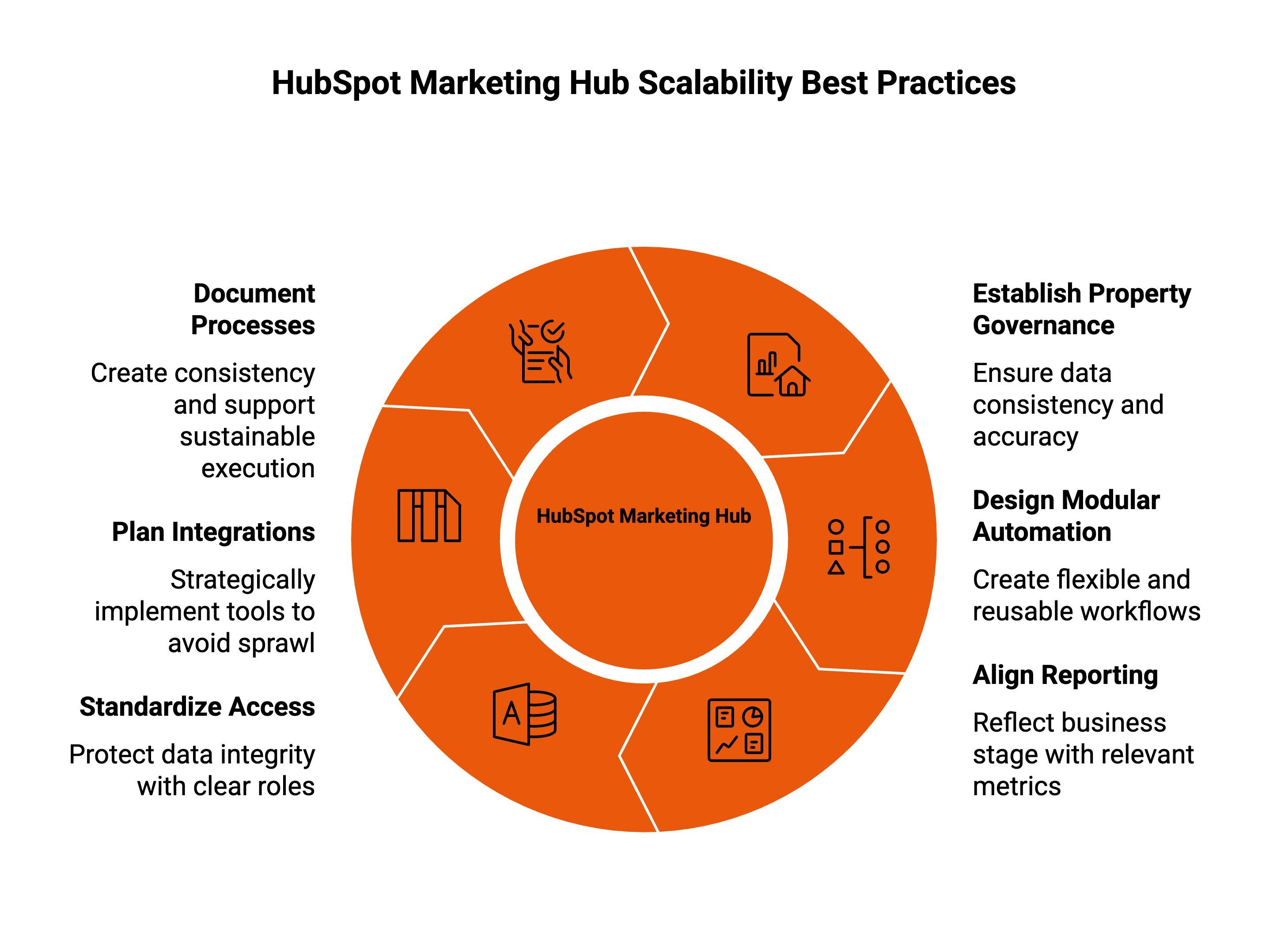
Even with a scalable platform, long-term success depends on how teams structure and manage it. Following proven scalability best practices ensures HubSpot Marketing Hub continues to support growth, complexity, and performance without creating operational bottlenecks or data management challenges.
1. Establish Clean Property Governance Early
Strong property governance ensures CRM and marketing data remain consistent as databases expand. Clear naming conventions, ownership rules, and documentation prevent data fragmentation, support accurate segmentation, and enable reliable reporting as teams scale campaigns and workflows.
2. Design Modular Automation Frameworks
Modular automation allows workflows to evolve without full rebuilds. Reusable logic supports expanding campaigns, additional lifecycle stages, and new channels, helping teams reduce technical debt while maintaining flexibility as marketing complexity increases.
3. Align Reporting With Business Maturity
Performance dashboards should reflect the business stage, not static metrics. As companies grow, reporting must evolve to track pipeline contribution, expansion revenue, and lifecycle progression, ensuring marketing insights remain relevant to leadership decisions.
4. Standardize Team Access And Permissions
Clear user roles and permission structures protect data integrity as teams expand. Standardized access controls ensure the right people have the right visibility, supporting collaboration while minimizing risk and preserving governance across marketing operations.
5. Plan Integrations With Scalability In Mind
Integrations should be implemented strategically to avoid tool sprawl. Evaluating long-term data flow, ownership, and maintenance ensures connected systems support growth rather than introducing complexity that slows performance or limits reporting accuracy.
6. Document Processes And Governance Rules
Documented processes create consistency as teams grow and onboard new members. Clear guidelines for campaign creation, automation changes, and data management reduce dependency on individuals and support sustainable, repeatable execution.
Following these scalability best practices reduces friction, protects data quality, and supports long-term operational maturity as marketing teams grow.
How Does ProofFlow Help HubSpot Teams Turn Customer Proof Into a Growth Engine?
ProofFlow is built exclusively for HubSpot teams that want customer proof to live where their revenue data already exists, inside the CRM. Instead of juggling forms, spreadsheets, and disconnected testimonial tools, ProofFlow automates the entire proof lifecycle using HubSpot workflows.
It identifies happy customers, sends personalized video or text requests, manages approvals, and syncs everything back to contact records in real time. Marketing teams gain ready-to-use testimonials, logo walls, and widgets without manual formatting, while agencies can scale proof collection across multiple clients with confidence.
The result is faster trust-building, cleaner workflows, and customer proof that actually supports conversions, without ever leaving HubSpot.
Get started free today and start automating customer proof directly inside HubSpot — 100% free during beta.
Final Thoughts
HubSpot Marketing Hub is designed to scale from startup to mid-size and beyond, especially for B2B SaaS companies that depend on measurable, repeatable growth.
With connected CRM data, automation that evolves with your strategy, and reporting that aligns with revenue outcomes, HubSpot Marketing Hub scalability for growing teams is a strong choice for companies serious about scaling inbound and outbound efforts.
Frequently Asked Questions
What are some success stories of B2B SaaS companies scaling with HubSpot Marketing Hub?
Many B2B SaaS companies report scaling demand generation with HubSpot Marketing Hub through improved lead nurturing, lifecycle automation, and attribution reporting, resulting in higher pipeline velocity, better alignment, and measurable revenue growth without adding operational complexity globally today.
What are the biggest challenges B2B SaaS companies face when scaling marketing, and how does HubSpot address them?
Common scaling challenges include fragmented data, manual workflows, unclear attribution, and misalignment between sales and marketing. HubSpot addresses these with centralized data models, automation, shared reporting, and standardized processes that improve visibility, consistency, and execution speed across teams.
Can HubSpot Marketing Hub handle the data and reporting needs of fast-growing B2B SaaS companies?
Yes, HubSpot Marketing Hub supports growth by handling large datasets, custom properties, and advanced reporting. It enables scalable dashboards, cohort analysis, and attribution models, allowing teams to track performance accurately as contacts, campaigns, and revenue data expand rapidly.
Why do B2B SaaS companies prefer HubSpot Marketing Hub for scalability compared to other marketing platforms?
B2B SaaS companies prefer HubSpot Marketing Hub because it balances ease of use with enterprise capabilities, offering automation, analytics, and integrations in one platform, reducing tool sprawl, onboarding time, and operational friction as marketing teams scale efficiently globally.
Which HubSpot tools or integrations are best for automating the marketing processes of a growing SaaS business?
Key tools include workflows, lead scoring, email automation, and reporting dashboards, plus integrations with CRM, product analytics, and customer success platforms. Together, they automate campaigns, improve targeting, and ensure consistent execution as SaaS marketing operations grow predictably and sustainably.
Ready to automate your testimonial collection?
Get full access to ProofFlow at no cost during our free beta. The complete testimonial automation platform for HubSpot.
Get Started Free