Senja.io vs ProofFlow: Which Testimonial Platform Is Right for You?

Key Highlights
-
Senja.io and ProofFlow are popular tools for collecting and displaying customer testimonials in 2026.
-
Senja.io focuses on simple testimonial collection and visual widgets, especially for creators and small SaaS teams.
-
ProofFlow is built exclusively for HubSpot, turning testimonials into first class CRM data synced to contacts and companies.
-
Senja excels in ease of use and affordability, while ProofFlow runs inside HubSpot using workflow actions, lifecycle triggers, and two-way CRM sync, so proof stays in your system of record.
-
Senja is ideal for solopreneurs and early-stage teams, whereas ProofFlow fits HubSpot marketing teams and HubSpot agencies managing multiple client portals.
-
Pricing differs significantly, with Senja offering low-cost plans and ProofFlow positioned as a premium automation-first solution.
-
Teams that want automated proof collection without disconnected tools, CSV exports, or Zapier choose ProofFlow.
Customer trust drives conversions, and testimonials remain one of the strongest forms of social proof. Traditionally, companies rely on manual outreach, email follow-ups, spreadsheets, and static website quotes to collect and publish testimonials. While this approach works at a small scale, it quickly becomes inconsistent, time-consuming, and difficult to measure.
An automated testimonial strategy changes the game. Instead of chasing testimonials manually, dedicated platforms centralize collection, streamline approvals, and turn customer feedback into conversion-driving assets across your website and campaigns. The challenge for many growing teams is this: your CRM knows everything about your customers, deal stages, lifecycle status, product usage, revenue, except for proof.
Testimonials often live outside the CRM in a separate tool, disconnected from the very data that should trigger and personalize them. Many testimonial platforms, including standalone tools like Senja, collect and manage testimonials inside their own dashboards. While this works for simple collection and publishing, it creates a layer between customer proof and the CRM data that drives revenue workflows.
ProofFlow takes a different approach. Instead of operating as a separate testimonial system, it is built to work natively inside HubSpot, using CRM data to trigger requests and syncing approved testimonials directly to contact and company records.
Both Senja and ProofFlow help businesses capture, manage, and publish customer feedback. However, they are fundamentally different in architecture. Senja operates as a standalone testimonial platform with its own dashboard and workflows, while ProofFlow is designed as a HubSpot-native solution that works directly within your CRM environment.
In this guide, we’ll compare Senja.io vs ProofFlow, breaking down features, use cases, pricing, limitations, and ideal customers so you can confidently choose the right platform.
What Is Senja.io?

Senja.io is a lightweight testimonial collection and display platform designed to make gathering customer feedback quick and straightforward. It’s especially popular among indie founders, creators, and small SaaS teams who want an easy way to request, store, and showcase testimonials.
Senja focuses on simplicity. Users can send testimonial requests, collect text or video feedback, and publish testimonials using clean, embeddable widgets, without heavy setup or technical complexity.
What Are The Key Features of Senja.io?
Senja.io focuses on simplicity and fast deployment, making testimonial collection easy for creators and early-stage teams.
| Feature | What It Means |
|---|---|
| Simple Testimonial Collection | Collect text and video testimonials via shareable links and easy-to-use forms. |
| Visual Testimonial Widgets | Embed customizable testimonial widgets on landing pages and websites. |
| Centralized Testimonial Library | Store and organize testimonials in one clean dashboard for reuse. |
| Creator-Friendly UX | Clean interface with minimal learning curve and no complex setup required. |
| Basic Automation | Limited automation through manual triggers and simple integrations. |
Overall, these features make Senja well-suited for teams seeking fast social proof with minimal operational complexity.
What Are The Limitations of Senja.io?
While Senja is easy to use, its simplicity can become restrictive for teams that require advanced automation, deeper insights, or scalable testimonial operations.
-
Limited Workflow Automation Testimonial requests are not tightly integrated with customer lifecycle events, making it difficult to trigger requests based on milestones such as onboarding completion or renewals.
-
Shallow Analytics Reporting is limited to basic engagement metrics, offering little visibility into testimonial performance, attribution impact, or how social proof influences conversion outcomes.
-
Scaling Challenges As testimonial volume increases, manual processes become harder to manage, creating inefficiencies for growing teams handling multiple campaigns or customer segments.
-
Limited Personalization Logic There is minimal control over conditional logic, reducing the ability to personalize testimonial requests based on customer behavior, usage patterns, or account attributes.
-
Not Built for Enterprise Processes Senja lacks advanced features like approval workflows, compliance controls, and routing logic required by larger organizations with formal review and governance needs.
These limitations can make Senja less suitable for teams prioritizing scale, automation depth, or enterprise-grade processes.
What Are the Main Use Cases of Senja.io?
Senja.io works best in scenarios where simplicity, speed, and low operational overhead matter more than advanced automation or analytics.
-
Landing Page and Website Testimonials Teams use Senja to quickly collect and display testimonials on landing pages, helping improve trust and conversion rates without investing in complex testimonial infrastructure.
-
Creator Portfolios and Personal Brands Independent creators leverage Senja to showcase client feedback and video testimonials, strengthening credibility while maintaining a simple, easy-to-manage setup.
-
Early-Stage SaaS Social Proof Startups use Senja to gather early customer testimonials that validate product value and support marketing efforts during initial growth stages.
-
Simple Video Testimonial Collection The platform is commonly used for lightweight video testimonials where speed and ease of submission are more important than production-level customization.
-
One-Off Testimonial Campaigns Senja fits short-term campaigns or launches where teams need fast testimonial collection without building long-term, automated testimonial systems.
In summary, Senja is best suited for straightforward testimonial needs rather than complex, scalable testimonial operations.
What Is ProofFlow?
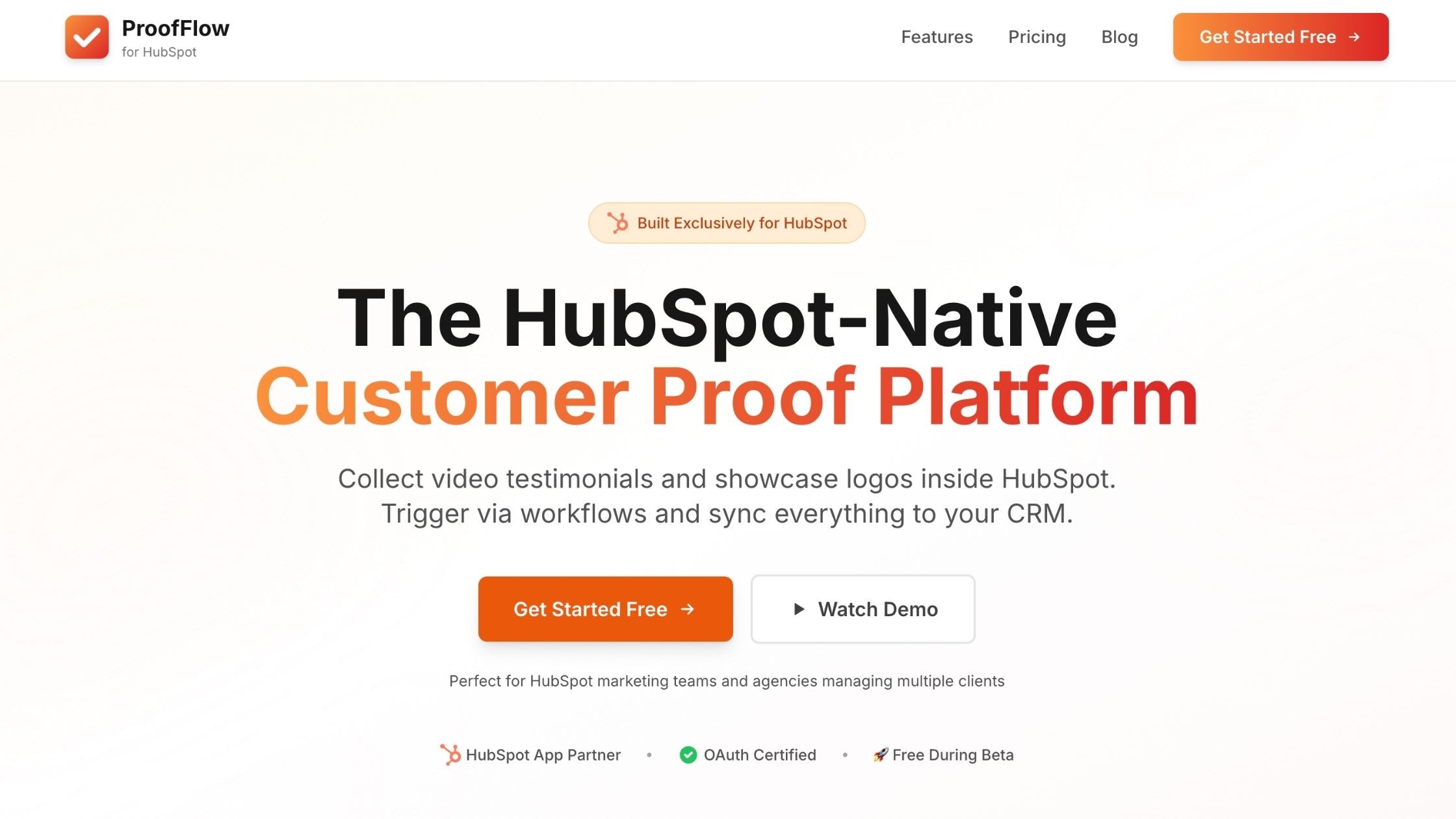
ProofFlow is a HubSpot-native testimonial solution built entirely inside HubSpot. It uses existing HubSpot objects, properties, and HubSpot workflow actions to trigger testimonial requests automatically.
Most importantly, it writes approved testimonials back into HubSpot as properties and timeline activity, turning testimonials into first-class CRM data instead of storing them in a separate tool.
Unlike siloed testimonial platforms, spreadsheets, or Zapier-based workarounds, ProofFlow eliminates disconnected systems. There’s no external dashboard acting as a secondary database. Instead, testimonials live inside HubSpot with a two-way sync to contact and company records.
Requests can be triggered by lifecycle stage, deal stage, NPS or CSAT scores, or any custom properties, ensuring proof is collected at the right moment and stored in your single source of truth. The result is testimonials as CRM data that can be segmented, reported on, and activated across marketing and sales workflows.
What Are The Winning Features of ProofFlow?
ProofFlow is designed for SaaS and growth-stage teams that want testimonial collection embedded directly into customer journeys with minimal manual effort.
| Feature | What It Means |
|---|---|
| HubSpot-Native Integration | The only testimonial tool with true HubSpot workflow action integration. Testimonial requests are triggered directly from CRM events like deal closed-won, onboarding completion, renewals, lifecycle stage changes, or custom properties. |
| Automated Testimonial Workflows | Uses HubSpot workflow actions to automatically send requests based on lifecycle stage, deal stage, NPS or CSAT scores, and other HubSpot object properties. |
| CRM-Centric Testimonial Storage | Testimonials are stored as CRM records inside HubSpot, not in an external database, making them visible and reportable across teams. |
| Two-Way HubSpot Sync | Stores testimonial URL, status, tags, and timeline activity directly in HubSpot contact and company records, ensuring testimonials as CRM data remain actionable. |
| Smart Routing & Segmentation | Segments customers using HubSpot lists, properties, and object filters to request feedback from the right audience at the right time. |
| Approval & Moderation Pipelines | Structured approval workflows that sync updates back to HubSpot records, keeping testimonial status aligned with CRM data. |
| Scalable Testimonial Management | Handles high testimonial volume without increasing manual effort because automation runs natively inside HubSpot. |
| Multi-Channel Publishing | Enables teams to reuse CRM-synced testimonials across website pages, sales decks, outbound campaigns, and enablement assets. |
| Built for HubSpot Teams | Designed for HubSpot marketing teams, agencies managing multiple portals, and RevOps teams who want proof tied directly to lifecycle, deals, attribution, and reporting. |
Together, these features position ProofFlow as a systemized, automation-first testimonial platform for growing organizations.
What Are Some Limitations of ProofFlow?
While powerful, ProofFlow prioritizes automation and scalability, which may not align with teams seeking lightweight or instant-use testimonial tools.
-
Best experience requires HubSpot because it is built exclusively for HubSpot.
-
Not ideal for creators who want a standalone tool with no CRM.
-
Requires defining HubSpot triggers and properties for initial workflow setup.
These trade-offs are intentional, favoring long-term efficiency over simplicity or visual flair.
What Are The Use Cases Of ProofFlow?
ProofFlow excels in environments where testimonial collection must scale, remain consistent, and operate continuously without manual intervention.
-
Always-On Testimonial Collection for SaaS SaaS companies use ProofFlow to continuously collect testimonials as customers progress through onboarding, adoption, and success milestones.
-
Post-Milestone Testimonial Automation Teams automate testimonial requests after key events like feature adoption, renewals, or upgrades, improving relevance and response rates.
-
Sales Enablement with Verified Proof Sales teams leverage approved testimonials to support outbound messaging, deal acceleration, and objection handling with credible customer validation.
-
Case Study Pipelines and Proof Libraries ProofFlow helps build organized libraries of testimonials and case studies that can be reused across marketing, sales, and customer success initiatives.
-
Reducing Manual Follow-Ups Customer marketing teams eliminate repetitive follow-ups by automating testimonial requests, approvals, and publishing workflows end-to-end.
Overall, ProofFlow is best suited for teams treating testimonials as a core, operational growth asset rather than a one-off marketing task.
Which Testimonial Tool Is Better: Senja.io or ProofFlow?
Choosing between Senja.io and ProofFlow depends on how advanced your testimonial strategy needs to be, especially around automation, scalability, and team collaboration.
The table below compares both platforms across key factors that matter most as teams grow, testimonial volume increases, and operational efficiency becomes critical.
| Feature | Senja.io | ProofFlow |
|---|---|---|
| Where Testimonials Are Stored | Separate platform dashboard | HubSpot CRM records (contacts and companies) |
| HubSpot Workflow Actions | No | Yes, native workflow actions and triggers |
| Primary Focus | Simple testimonial collection | Automated testimonial workflows inside HubSpot |
| Best For | Creators and early-stage teams | SaaS and growth-stage HubSpot-driven businesses |
| Automation Level | Light automation, mostly external triggers | HubSpot-native automation using CRM properties and lifecycle milestones |
| Setup Time | Minutes | Short setup, long-term automation |
| Scalability | Limited | Built for scale |
| Personalization | Basic | Advanced lifecycle-based logic |
| Analytics | Minimal | Workflow and performance-focused |
| Team Collaboration | Limited | Strong |
| Approval Workflows | No | Yes |
| Manual Effort Over Time | Increases as volume grows | Decreases through automation |
| Affordability | Lower cost | Premium, ROI-driven for HubSpot teams |
| HubSpot Integration | No native integration | Native HubSpot workflow integration |
| CRM Storage | External database | Testimonials stored as CRM records |
| Target Audience | Creators, indie founders | HubSpot agencies, B2B marketing teams |
| Data Centralization | Siloed tool | CRM-first, consolidated data |
Both platforms serve different growth stages and operational needs. The right choice depends on whether you prioritize simplicity and low upfront cost or long-term automation and scalable testimonial management.
Senja Pricing vs ProofFlow Pricing: How Do They Compare?
Pricing models often reflect how a testimonial tool is meant to be used. Senja and ProofFlow take very different approaches; one prioritises accessibility and feature volume, while the other focuses on automation, learning, and long-term value. Below is a clear breakdown using the same structure for easy comparison.
Senja Pricing
Senja offers one of the most accessible pricing models in the social proof space, making it popular with creators and smaller teams looking to get started quickly.
-
Entry Plan: Free forever plan with up to 15 testimonials, basic collection forms, widgets, tagging, imports, and simple analytics. unlock unlimited testimonials, branding removal, integrations, HD exports, and team access.
-
Paid plans: Higher paid tiers expand usage limits, automation integrations, custom domains, and collaboration features. No heavily segmented enterprise tier, but scalable within premium plans.
Best Suited For: Creators, solopreneurs, indie SaaS founders, and small teams prioritizing affordability, simplicity, and feature breadth without complex operational workflows.
Senja’s pricing is creator-friendly, feature-rich, and ideal for budget-conscious teams that want flexibility and breadth.
ProofFlow Pricing
ProofFlow is currently offered through a public beta, with a pricing approach centred on learning, automation, and long-term ROI rather than tiered feature limits.
-
Entry Plan ($0/month): Currently free during public beta with full platform access, including unlimited testimonials, automated workflows, CRM integrations, and embeddable widgets.
-
Mid / Enterprise Positioning: Public tiered pricing is not yet announced, but positioning suggests future plans will focus on automation depth, workflow volume, and team-level scalability rather than feature caps.
Best Suited For: SaaS and growth-stage teams that want testimonial collection embedded into lifecycle workflows and aligned with revenue operations, prioritizing automation and long-term efficiency.
ProofFlow’s pricing reflects a premium, ROI-driven philosophy, focusing on teams where testimonials are deeply connected to revenue, customer success, and scalable operations. Designed for teams where testimonials directly impact revenue.
How Do Senja.io and ProofFlow Compare Head-to-Head?
After reviewing features and pricing, here’s a direct comparison across the dimensions that matter most for growing SaaS teams and operational efficiency.
1. Automation Depth
Senja.io offers light automation with manual triggers and simple integrations, making it suitable for straightforward testimonial collection.
ProofFlow runs as a HubSpot-native workflow action inside HubSpot, using properties like lifecycle stage, deal stage, NPS, CSAT, and custom object properties to trigger requests and write results back to contact and company records. Testimonials are written back as timeline activity and structured properties, turning proof into CRM data.
ProofFlow is not another silo layered on top of your stack. It operates entirely inside HubSpot, meaning automation, triggering, and reporting all live where your revenue data already exists.
2. Operational Scalability
Senja works well at small to moderate testimonial volumes, but manual effort increases as the collection grows because testimonials live in a separate platform.
ProofFlow is built for scale inside HubSpot. Because testimonials are stored as CRM records with two-way sync to contact and company records, high volume does not create operational complexity. Requests are triggered automatically inside HubSpot based on deal movement, onboarding completion, renewals, or property updates.
Agencies especially benefit from multi-portal standardization, deploying the same HubSpot-native testimonial system across multiple client accounts without managing separate tools per client.
3. Team Collaboration
Senja primarily serves individual users or small teams with limited collaboration needs, with testimonial management happening in an external dashboard.
ProofFlow enables structured collaboration directly inside HubSpot. Marketing, Sales, Customer Success, and RevOps teams can see testimonial status on contact and company records, review approvals, and track timeline activity without leaving the CRM.
Because proof becomes CRM data, every team works from a shared system of record, not screenshots or exported quotes from another platform.
4. Analytics Visibility
Senja provides basic tracking and organizational visibility around testimonials collected within its platform.
ProofFlow provides operational visibility inside HubSpot. Teams can report on testimonial requests triggered by lifecycle stage, deal stage, NPS, or custom properties, and measure performance using standard HubSpot reporting tools.
Since testimonials are stored as CRM data, attribution, segmentation, and reporting align directly with revenue metrics — eliminating disconnected analytics across tools.
5. Long-Term Efficiency
With Senja, testimonial collection often requires ongoing manual involvement because it operates as a separate testimonial tool.
ProofFlow reduces recurring effort by embedding automation directly inside HubSpot. Once configured, testimonial requests are triggered automatically by CRM events, and approved testimonials are synced back to records without manual transfer.
ProofFlow is not another silo; it replaces spreadsheets, Zapier connections, and disconnected dashboards. Instead of managing testimonials as a side process, teams manage testimonials as CRM data tied directly to lifecycle movement, deals, and attribution.
Final Verdict: Who Should Choose What?
Choose Senja.io if you prioritize simplicity, fast setup, and lower upfront cost for standalone testimonial collection.
Choose ProofFlow if you want automation embedded into customer journeys inside HubSpot, testimonials treated as CRM data, and a scalable multi-portal standard.
Conclusion
Both platforms are excellent, but they solve different problems. Senja.io helps you start collecting testimonials quickly. ProofFlow helps you never think about collecting testimonials again.
If testimonials are a growth lever, not a side task, ProofFlow offers a more scalable and future-proof approach. If you’re just getting started or need something lightweight, Senja remains a solid choice.
Frequently Asked Questions
Is ProofFlow a Senja.io alternative?
Yes. ProofFlow is a strong Senja.io alternative for teams that want testimonial software built around automation, scalability, and structured workflows, making it easier to collect customer feedback consistently as volume and complexity grow.
How do Senja reviews compare to ProofFlow?
Senja reviews often highlight ease of use and simplicity. ProofFlow feedback typically focuses on automation, sentiment analysis, and better organization of testimonials, helping teams reduce manual effort while showcasing happy customers more consistently.
Does Senja offer better pricing?
Senja generally feels more affordable upfront and offers a free tier. ProofFlow is currently free during public beta with full platform access, and emphasizes long-term ROI through automation, customizable forms, and deeper capabilities designed to support growth without relying on manual processes.
How does ProofFlow work inside HubSpot?
ProofFlow operates natively inside HubSpot using workflow actions and CRM properties to trigger testimonial requests automatically. Instead of relying on social media imports or a free plan dashboard, testimonials sync directly to contact and company records as structured CRM data.
What HubSpot properties can ProofFlow use as triggers?
ProofFlow can trigger requests using lifecycle stage, deal stage, NPS, CSAT, renewal dates, onboarding completion, or custom properties. Unlike walls of love tools, automation runs through HubSpot workflows, ensuring testimonials are captured contextually and written back as CRM data.
Where is testimonial data stored in HubSpot?
Testimonial data is stored directly inside HubSpot contact and company records with two-way sync. Instead of living in an external wall of love database, ProofFlow saves URLs, approval status, tags, and structured properties within HubSpot objects.
Can agencies manage multiple HubSpot portals?
Yes, agencies can standardize testimonial automation across multiple HubSpot portals. Rather than juggling separate vocal video tools or dashboards, ProofFlow keeps workflows consistent, ensuring authentic video testimonials and written proof are stored as CRM data across accounts.
Does ProofFlow create HubSpot timeline events or properties?
ProofFlow creates HubSpot timeline events and structured properties tied to contact and company records. Unlike basic video editing platforms or unlimited widgets plugins, it ensures testimonial activity becomes searchable, reportable CRM data inside HubSpot.
How do approvals work in HubSpot?
Approvals happen inside HubSpot through structured workflow stages and property updates. Once approved, testimonials sync to records and can support rich snippets on websites, without exporting data to external dashboards or relying on manual publishing systems.
What are the most popular alternatives to both Senja.io and ProofFlow?
The most popular alternatives to Senja.io and ProofFlow include Testimonial.to, Vocal Video, Trustmary, Boast.io, Famewall, and VideoPeel. These tools focus on video collection, social media imports, walls of love, free plan options, unlimited widgets, video editing, authentic video testimonials, and rich snippets for website visibility.
Ready to automate your testimonial collection?
Get full access to ProofFlow at no cost during our free beta. The complete testimonial automation platform for HubSpot.
Get Started Free